
Barry County Release Date Meanings
There is no single projected-release field that works for every Barry County case. A pretrial detainee may leave the detention center after bond conditions are met, a judge enters an order, a hold clears, or another custodian takes the person. Until those events occur, no fixed date may exist. The Sheriff’s roster can show a bond amount, but that amount does not prove payment or establish a release time. Jail staff and the court record answer different parts of the question.
A definite county commitment starts with the judgment, jail credit, and the Barry County Detention Center’s calculation. No Barry County publication located in the research gives a local good-time formula or weekend and holiday early-release rule. For state custody, MODOC records use sentence minimum and maximum dates, and its public guide also recognizes parole or conditional-release dates. Each date describes a different stage.
| Date or event | What it means | Where to confirm it |
|---|---|---|
| County release time | The Barry County booking ended at the detention center. | Sheriff 48 Hour Release row and Jail inmate file. |
| Sentence minimum date | A calculated minimum on an active MODOC sentence line. | MODOC Sunshine layout and caseworker. |
| Parole date | A Board-set release into community supervision. | Board decision, MODOC record, and field office. |
| Conditional-release date | A statutory release-to-supervision point for an eligible sentence. | MODOC record and responsible caseworker. |
| Sentence maximum | The expiration date recorded for that sentence line. | MODOC Sunshine data or records response. |
| Discharge | The relevant sentence or supervision has ended. | Completed flag, discharge paper, agency record, and court file. |
Find a Barry County Release Date
Start with the system that now controls custody. A county roster exit, state prison release, and federal release are separate events. A transfer from Barry County to MODOC ends the county booking but does not put the person in the community. Likewise, parole can end confinement while state supervision continues. The search path should follow that change in custodian.
- Identify whether the person is pretrial, serving a county commitment, in state custody, or under active community supervision.
- Obtain the Barry County judgment and sentence through Case.net. Compare the cause number with the booking or MODOC record.
- For county custody, call the Barry County Detention Center at 417-847-3461 and ask about the current lawful release calculation or transfer.
- For state custody, search the MODOC Offender Web Search, match the DOC number, and record only dates actually displayed.
- Use MODOC’s Sunshine file or a records request for the sentence minimum, sentence maximum, completed flag, and historical lines.
- Ask the Jail caseworker, institutional caseworker, or field probation and parole officer to explain the current calculation.
- Use VINE or MOVANS for notice, then confirm the physical release with the agency that held the person.
The interactive MODOC search covers active offenders, including probationers and parolees. It expressly excludes discharged offenders. An absent name does not prove that a sentence ended. Search a documented alias when appropriate, then move to historical records and the court file. The Barry County released inmates search covers the county record path in full.
The MODOC search landing visibly states its active-record limit.
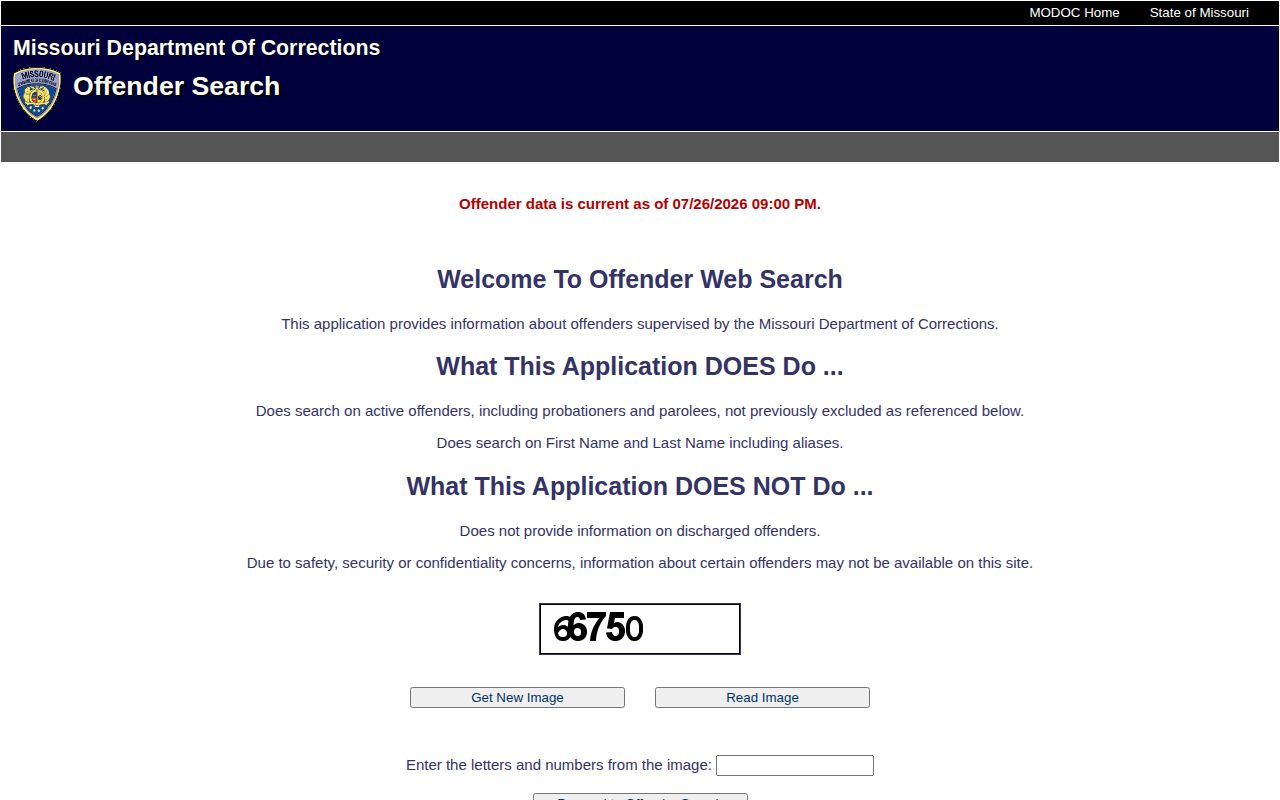
This limitation is why the historical Sunshine channel is essential after final discharge.
Note: A county booking number, DOC number, and court cause number identify different records, so keep all three when they exist.
Barry County Release Date Records
MODOC’s nightly Sunshine offender file is the distinctive state channel for dates that cannot be safely inferred from the interactive search. The file can include current and historical supervision data as early as 1974. One person may have several rows because each charge or sentence can create a record. Read each line at the sentence level and seek clarification when minimum, maximum, or completed values conflict.
| Official field | Release-date use |
|---|---|
| G0$DOC | Matches the sentence line to the person’s state DOC identifier. |
| Cause number and sentence county | Connects the MODOC line to a Barry County court case. |
| G0$SCF Completed Flag | A value of Y means that sentence line is completed. |
| G0$PC Sentence-I Minimum Release Date | Calculated minimum release date on an active sentence, subject to documented special values. |
| G0$PD Sentence Maximum Release Date | Maximum release or expiration date for that sentence line. |
| G0$CCI | Shows the concurrent or consecutive indicator, which can affect the overall calculation. |
| Probation date, type, and term | Describes the community-supervision structure when applicable. |
No official source verified an interactive field literally labeled “Projected Release Date” or “Tentative Release Date.” The minimum and maximum labels above come from the Sunshine layout. The public probation and parole guide separately recognizes parole or conditional-release dates. Combining those distinct labels into a made-up search field would give a false result.
The MODOC Sunshine page documents the historical file and sentence fields.
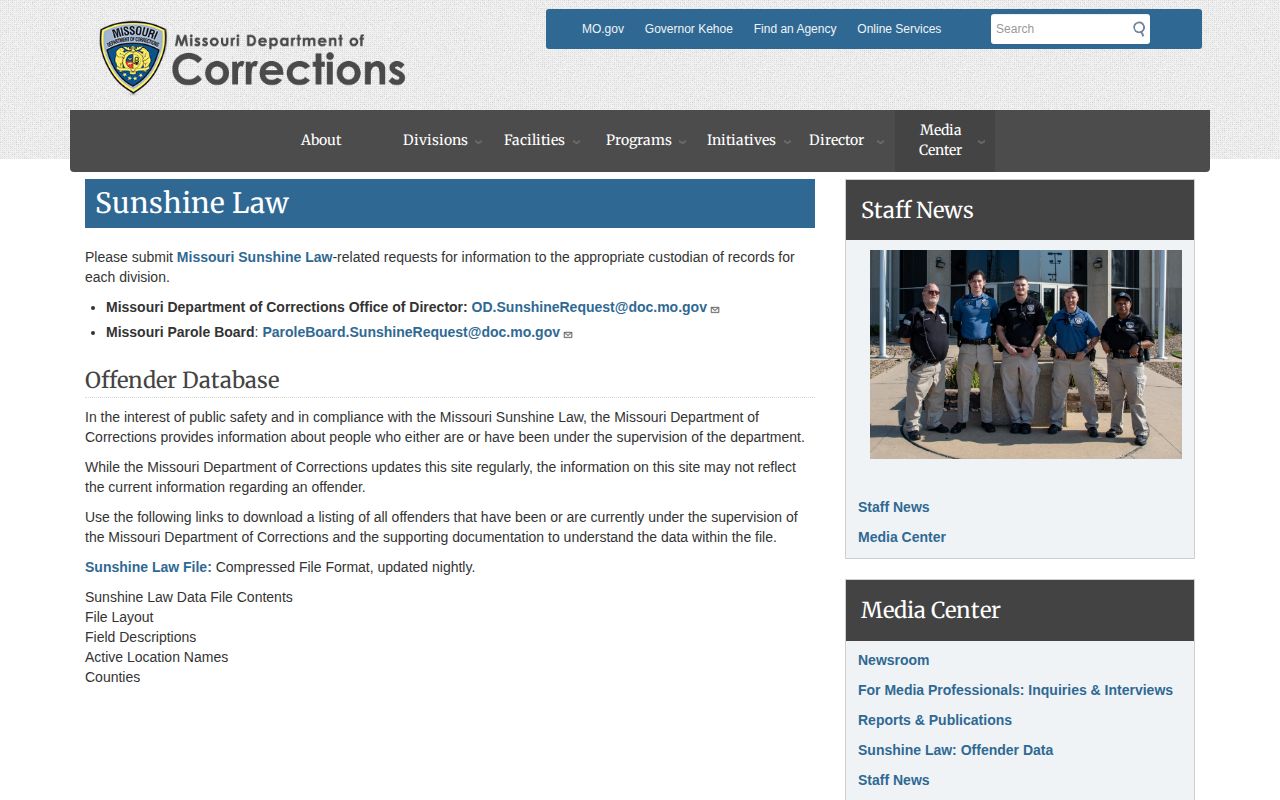
The captured field explanation supports reading a date as one part of a sentence record, not as a guaranteed day of release.
Missouri Conditional Release Calculations
RSMo § 558.011 generally divides an eligible felony term of years into a prison term and a conditional-release term. For a term of nine years or less, the conditional-release part is one-third. For a term longer than nine through fifteen years, it is three years. For a term longer than fifteen years, it is five years. The prison term is the rest.
Those are general statutory components, not a stand-alone calculator for any named Barry County prisoner. Dangerous felonies and a fourth or later MODOC remand are exceptions to the general structure. The Board may extend a conditional-release date up to the full sentence after the statutory violation and hearing process. Other statutes, sentence wording, and case facts can also control.
The official conditional-release statute is shown in the matched manifest capture.
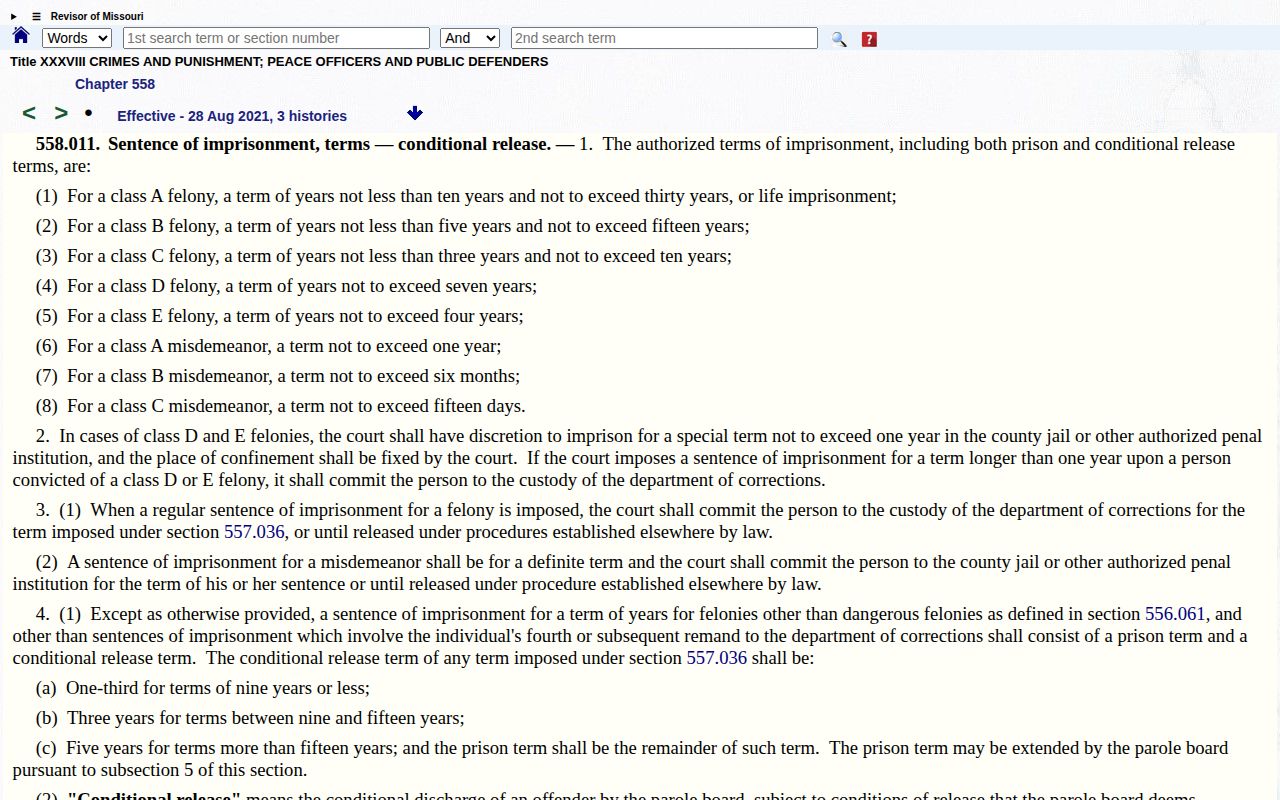
The statute should be read with the judgment and current agency calculation before treating any date as final.
Conditional release means incarceration has ended for that stage while supervision begins. It is not complete discharge. A Board extension, violation process, or new lawful order can alter the expected path before the sentence maximum.
Barry County Minimum Prison Terms
Missouri does not impose a generic rule that every prisoner must serve 85 percent. RSMo § 558.019 contains offense and prior-commitment categories. For a dangerous felony as defined in § 556.061, subsection 3 generally requires 85 percent of the sentence or the age-seventy and 40-percent alternative, whichever comes first. A legal review must determine whether that category applies to a specific offense and judgment.
For listed non-dangerous offenses, subsection 2 sets other minimum terms based on prior MODOC felony commitments. The research records 40 percent after one prior commitment, 50 percent after two, and 80 percent after three or more, subject to the statute’s qualifications. The calculation treats life as thirty years and an aggregate above seventy-five years as seventy-five for this purpose. These figures describe minimum time before eligibility for parole, conditional release, or another early-release route. They do not by themselves produce the actual release date.
The Missouri minimum-term statute is captured below because it is the source for the distinct percentage categories.
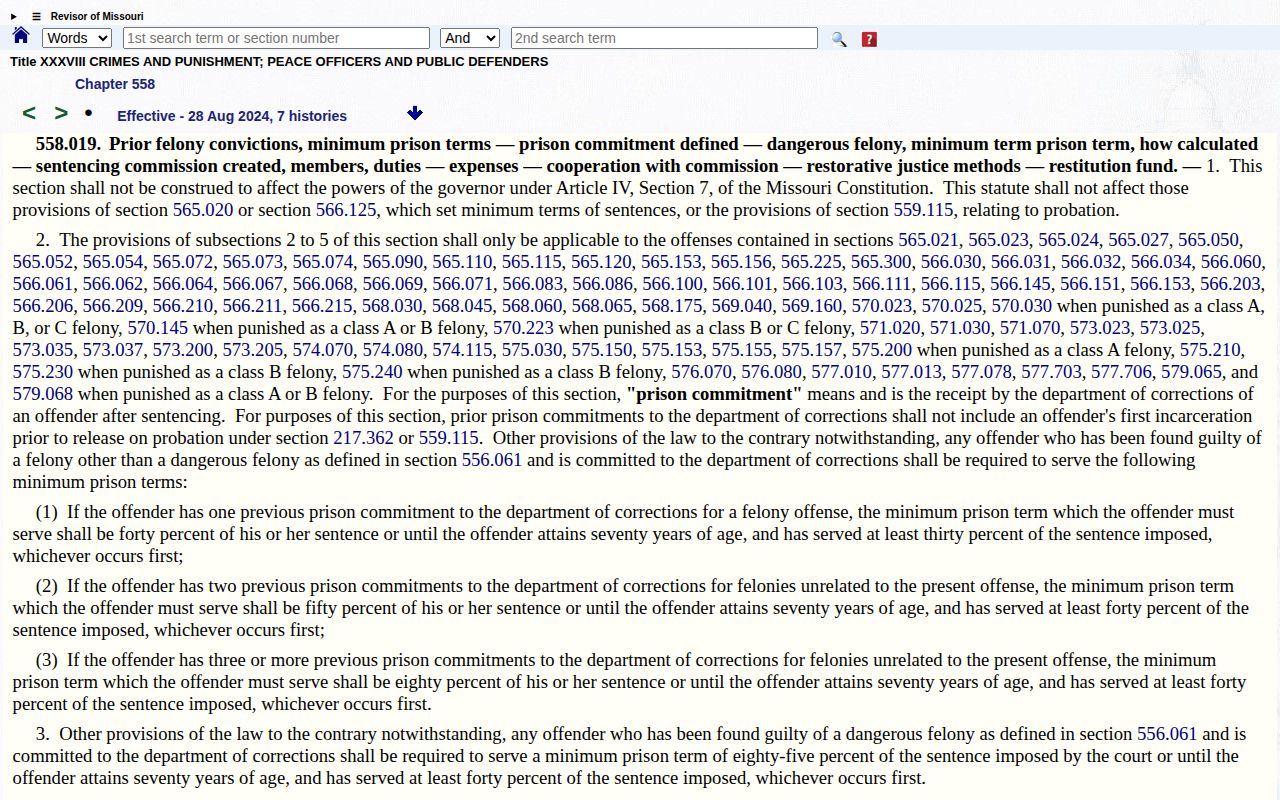
This statute capture helps prevent the common error of assigning an 85-percent rule to every MODOC sentence.
Why Barry County Release Dates Change
A projected date is based on the record and law known when it is calculated. Later events can alter the sentence line, eligibility point, custody path, or planned release. Some changes come from the court. Others come from the Parole Board, agency records, or an unresolved hold. Ask for the current calculation rather than relying on an old printout.
| Factor | Possible effect | Best source |
|---|---|---|
| Jail credit correction | Changes credited time on the sentence. | Judgment, court order, and jail or MODOC calculation. |
| Concurrent or consecutive ruling | Changes how multiple sentence terms combine. | Court record, G0$CCI field, and agency explanation. |
| New sentence or corrected judgment | Adds, removes, or revises controlling time. | Case.net and sentencing agency record. |
| Parole Board action | Sets a future release date or a later hearing. | Board decision and institutional parole officer. |
| Conditional-release extension | Moves release toward the full sentence after the required process. | Board and MODOC records. |
| Detainer or transfer | Ends one custody episode but may begin another. | Jail inmate file and receiving custodian. |
| Appeal or data correction | Changes the legal basis or fixes the recorded calculation. | Court, caseworker, and corrected agency record. |
A parole hearing does not itself release a person. The Board may set a future date or another hearing, and official decisions generally take time after the hearing. Required program consequences, a pending case, or a hold can also affect what happens on an expected date. The person may transfer rather than enter the community.
Earned compliance credit belongs to post-release supervision. Eligible compliant months can advance the supervision discharge date, while custody, absconding, and violation periods can interrupt credit. It should never be deducted from a prison term as though it were one month of prison good time.
Confirm Barry County Physical Release
Use the calculated date as a prompt to check, not as final proof. For the Barry County Detention Center, the Sheriff’s 48 Hour Release feed may supply an exact timestamp after the county booking closes. The Jail inmate file can state whether the person left to the community or transferred. Case.net can show the court order, but a docket time is not always the same as the time the person walked out or entered another agency’s custody.
For a state prisoner, confirm with MODOC or the responsible caseworker. A parole or conditional release normally begins community supervision, while a transfer remains custody. The Barry County VINELink release check can add a notification for a matched MODOC record, but alerts can lag and should be verified with the reporting agency.
Federal Bureau of Prisons and ICE custody use their own locators. A BOP result such as “Released” or “Not in BOP custody” speaks only to federal prison custody. An ICE result speaks only to immigration custody. Follow the actual transfer destination rather than treating a person’s disappearance from one system as proof of unrestricted release.
Note: The best final evidence pairs the agency’s actual release record with the court or sentence record that explains the legal basis.